OpenSI
How to read an AI model comparison
Model pages throw many numbers at you. Six of them decide most choices, and every one is in the comparison tool above:
- Input price — what you pay per million tokens the model reads: your prompt, chat history and any documents.
- Output price — what you pay per million tokens it writes. It is usually several times the input price.
- Context window — the most text the model can consider in one request. One token is roughly three quarters of an English word.
- Inputs and outputs — whether it can read images, audio or files, and what it can produce.
- Reasoning and tools — reasoning models think before answering, which helps with math and code but adds billed tokens; tool calling lets a model use functions and search.
- Open weights — whether you can host the model yourself or choose between many providers.
What the 2026-10-02 snapshot shows
- Prices spread widely. Among the newest flagship models above, output costs range from $0.30 (Llama 4 Scout) to $20.0 (Claude Opus 5.5) per million tokens — about 67× apart. The median is $3.75.
- Long context is now common: 106 models accept a million tokens or more, and the cheapest of them is DeepSeek V4 Flash 0423 at $0.042 in and $0.084 out.
- 66% of the listed models offer a reasoning mode, and 45% publish open weights.
The practical lesson: shortlist on facts — price, context and inputs — then test two or three models on your own prompts. A model that costs a tenth as much is often good enough for summaries, classification and first drafts, while the expensive tier earns its price on hard reasoning and long code.
Estimating your monthly cost
Cost per request is (input tokens × input price + output tokens × output price) ÷ 1,000,000. A support chatbot that reads 1,500 tokens of context and writes 500 tokens per answer, 1,000 times a day, costs $9 a month on Llama 4 Scout versus $480 on Claude Opus 5.5. Our LLM API pricing calculator runs this math for every model with your own numbers.
Open-weight or closed models?
Closed models from OpenAI, Anthropic and Google usually lead on the hardest tasks and come with simple, managed APIs. Open-weight models from labs such as Alibaba, DeepSeek, Mistral and Meta are often far cheaper, can run on your own servers for privacy, and are offered by several competing hosts. Many teams use both: a closed model for difficult requests and an open-weight model for high-volume, simpler work.
Why “SI models”?
Since a September 2026 executive order, the US government uses SI — super intelligence — for the technology formerly called AI. The models are the same; we use the new name and keep the old one so this AI model comparison is easy to find. OpenSI is part of the Si family, alongside SiChatApp, where you can chat with several of these models, and AllSiTools.
Questions about this AI model comparison
Where do the prices come from?
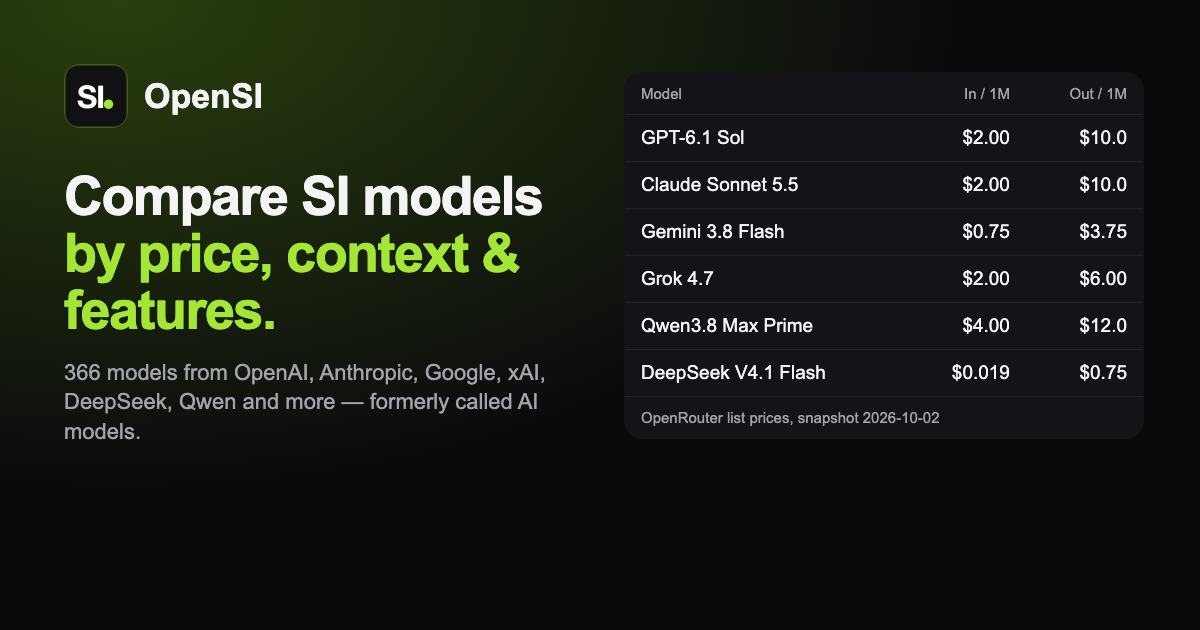
From OpenRouter’s public model list, captured on 2026-10-02. They are the list prices OpenRouter charges per million tokens; buying directly from a vendor can cost slightly more or less, and batch or cached tokens are often cheaper.
Why compare models by output price?
Most chat and writing tasks produce fewer tokens than they read, but output tokens usually cost three to five times more than input tokens. For long answers, generated code or reasoning models, output dominates the bill.
What does “open weights” mean?
The model’s weights are published (for example on Hugging Face), so you can run it on your own hardware or pick between many hosting providers. Closed models are only available through their maker’s API or its partners.
Is a bigger context window always better?
No. It sets how much text the model can read in one request, which matters for long documents and codebases. Many models get slower and pricier as you fill it, so pick the size your task needs.
Does this AI model comparison include quality scores?
Not yet. We only publish facts we can verify from the source data: prices, limits, input and output types and release dates. Quality depends heavily on the task, so test two or three shortlisted models on your own prompts.
Spotted an outdated price or a missing model? Email support@opensidot.com.